BULLYING
Definition
A Form of Harassment that includes acts of aggression by Service members or DoD civilian employees, with a nexus to military service, with the intent of harming a Service member either physically or psychologically, without a proper military or other governmental purpose. Bullying may involve the singling out of an individual from his or her coworkers, or unit, for ridicule because he or she is considered different or weak. It often involves an imbalance of power between the aggressor and the victim. Bullying can be conducted through the use of electronic devices or communications, and by other means including social media, as well as in person. See DoD Instruction 1020.03 for additional details.
Bullying Products
➤ Bullying Fact Sheet
➤ Bullying Fact Sheet References
➤ Bullying Quiz
➤ Bullying Focus Group Questions
➤ Facilitation Guide: Cyberbullying
Additional Information
For additional information on Bullying please click the link below where you will be directed to the EO/EEO Fair Treatment - Bullying tab. You will find Fact Sheets, Prevention Strategies, Online Lessons, Videos and additional training materials and resources.
➤ EO/EEO/ Fair Treatment - Bullying
BYSTANDER INTERVENTION
Bystander Intervention Products
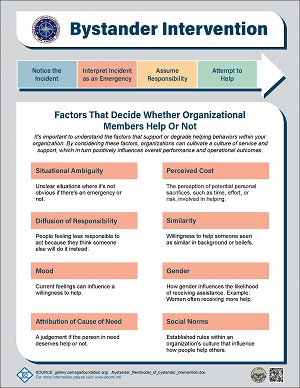
The following article specifies four components of a bystander intervention model: (1) notice the incident, (2) interpret the incident as an emergency, (3) assume responsibility, and (4) attempt to help. In addition, the article also identifies factors that influence helping behaviors.
This fact sheet specifies information regarding: (1) the importance of a bystander, (2) who is a bystander, (3) what the bystander effect is, (4) reasons bystanders remain passive, and (5) the bystander approach.
➤ Bystander Intervention Fact Sheet
➤ Presentation
➤ Prevention Strategies
➤ Facilitation Guide
Posters
Click on the poster image(s) to download the full-size product.
CRIMINAL ACTS
Definition
“Criminal Act for a Retaliatory Purpose in Connection with an Alleged Sex-Related Offense or Sexual Harassment” A “Criminal Act for a Retaliatory Purpose in Connection with an Alleged Sex Related Offense or Sexual Harassment” is any offense under the UCMJ committed in relation to what the perpetrator of the UCMJ offense knew or believed to be a sex related offense or sexual harassment, including the reporting or witnessing thereof, because the perpetrator knew or believed that: (1) a member reported a sex-related offense or sexual harassment; (2) a member was the victim of a sex-related offense or sexual harassment; (3) a member was reported by another as being the victim of a sex-related offense or sexual harassment; (4) a member intervened to prevent or attempt to prevent a sex-related offense or sexual harassment from occurring; or 27 (5) a member cooperated in an investigation or a member has served or will or may serve as a witness or otherwise cooperate in a future criminal, disciplinary, or administrative proceeding or investigation involving a criminal offense or sexual harassment. B. “Criminal Act for Performance of Duties Concerning an Alleged Sex-Related Offense or Sexual Harassment” A “Criminal Act for Performance of Duties Concerning an Alleged Sex-Related Offense or Sexual Harassment” is any offense under the UCMJ committed because the victim of that offense was a service member who performed duties in any of the following capacities in connection with an alleged sex-related offense or alleged sexual harassment: (1) a sexual assault response coordinator; (2) a victim advocate; (3) an equal opportunity or military equal opportunity advisor; (4) a mental health counselor; (5) a health care provider; (6) a Family Advocacy Program staff member; (7) a special victims’ counsel or victims’ legal counsel; (8) a legal assistance counsel; (9) a defense counsel; (10) a trial counsel; (11) a military judge; (12) an appellate military judge; (13) a non-attorney acting under the authority, supervision, or direction of a counsel listed above in subparagraphs (7) through (10) or a judge listed above in subparagraphs (11) or (12); (14) or an Inspector General.
Posters
Click on the poster image(s) to download the full-sized product.

DISCRIMINATORY HARASSMENT
Definition
A form of harassment that is unwelcome conduct based on race, color, religion, sex (including gender identity), national origin, or sexual orientation. See DoD Instruction 1020.03 for additional details.
Additional Resources/Tools
For additional information on Discrimination please click the link below where you will be directed to the EO/EEO Fair Treatment - Discrimination tab. You will find Fact Sheets, Prevention Strategies, Online Lessons, Videos and additional training materials and resources.
➤ EO/EEO/ Fair Treatment - Discrimination
HAZING
Definition
A form of Harassment that includes conduct through which Service members or DoD employees, without a proper military or other governmental purpose but with a nexus to military Service, physically or psychologically injures or creates a risk of physical or psychological injury to Service members for the purpose of: initiation into, admission into, affiliation with, change in status or position within, or a condition for continued membership in any military or DoD civilian organization. Hazing can be conducted through the use of electronic devices or communications, and by other means including social media, as well as in person. See DoD Instruction 1020.03 for additional details.
Hazing Products
Case Studies
Prevention Principles
➤ Orientation Paper
Additional Information
Annual Reports
Annual Reports on Hazing Prevention & Response in the Armed Forces.
➤ December 23 2015 – April 25 2016
For additional information on Hazing please click the link below where you will be directed to the EO/EEO Fair Treatment - Hazing tab. You will find Fact Sheets, Prevention Strategies, Online Lessons, Videos and additional training materials and resources.
MALTREATMENT
Definition
“Maltreatment” under Article 93, Uniform Code of Military Justice (UCMJ) (10 U.S.C. § 893): Maltreatment occurs when a person subject to the UCMJ is cruel toward, or oppresses or maltreats, any individual subject to the person’s orders. One form of maltreatment is cruelty toward, oppression of, or maltreatment of an individual subject to one’s orders because that individual: (1) reported a sex-related offense or sexual harassment or is believed to have reported a sex-related offense or sexual harassment; (2) was the victim of a sex-related offense or sexual harassment or is believed to have been the victim of a sex-related offense or sexual harassment; (3) was reported by another as being the victim of a sex-related offense or sexual harassment or is believed to have been reported by another as being the victim of a sex related offense or sexual harassment; (4) intervened, or attempted to intervene, to prevent or attempt to prevent a sex-related offense or sexual harassment or is believed to have intervened or attempted to intervene to prevent or attempt to prevent a sex-related offense or sexual harassment; or (5) has cooperated or is believed to have cooperated in an investigation, has served as a witness, will or may serve as witness, or is believed to have served as a witness, or it is believed that the individual will or may serve as a witness in the future in a criminal or disciplinary proceeding, or in an investigation, including an administrative investigation, involving a sex-related offense or sexual harassment.
OSTRACISM
Definition
Ostracism – The offense of “Ostracism” consists of: (1) with a nexus to military service, wrongfully excluding a military member from social acceptance or membership in or association with a group of which such military member was a part or a reasonable person would conclude wanted to be a part with the intent to do any of the following: (a) inflict emotional distress on the military member (“emotional distress” means a highly unpleasant mental reaction, such as anguish, grief, fright, humiliation, or fury); (b) discourage reporting of a criminal offense or sexual harassment; or (c) otherwise discourage the due administration of justice concerning a criminal offense or sexual harassment; and (2) because the perpetrator knew or believed that: (a) the member reported or was planning to report a criminal offense or sexual harassment; (b) the member was a victim or alleged victim of a criminal offense or sexual harassment; (c) the member was reported by another as being the victim of a criminal offense or sexual harassment; (d) the member intervened to prevent or attempt to prevent a criminal offense or sexual harassment from occurring; or (e) (e) the member cooperated in an investigation or the member has served or will or may serve as a witness or otherwise cooperate in the future in a criminal, disciplinary, or administrative proceeding or investigation involving a criminal offense or sexual harassment.
SEXUAL HARASSMENT
Definition
Conduct that involves unwelcome sexual advances, requests for sexual favors, and deliberate or repeated offensive comments or gestures of a sexual nature.
Sexual harassment is:
A. Conduct that:
1. Involves unwelcome sexual advances, requests for sexual favors, and deliberate or repeated offensive comments or gestures of a sexual nature when:
a. Submission to such conduct is made either explicitly or implicitly a term or condition of a person's job, pay or career;
b. Submission to or rejection of such conduct by a person is used as a basis for career or employment decisions affecting that person; or
c. Such conduct has the purpose or effect of unreasonably interfering with an individual's work performance or creates an intimidating, hostile or offensive working environment; and
2. Is so severe or pervasive that a reasonable person would perceive, and the victim does perceive, the environment as hostile or offensive.
B. Any use or condonation, by any person in a supervisory or command position, of any form of sexual behavior to control, influence, or affect the career, pay, or job of a member of the Armed Forces.
C. Any deliberate or repeated unwelcome verbal comments or gestures of a sexual nature by any member of the Armed Forces or civilian employee of the Department of Defense.
There is no requirement for concrete psychological harm to the complainant for behavior to constitute sexual harassment. Behavior is sufficient to constitute sexual harassment if it is so severe or pervasive that a reasonable person would perceive, and the complainant does perceive, the environment as hostile or offensive.
Sexual harassment can occur through electronic communications, including social media, other forms of communication, and in person.
Prevention Initiatives
This information is to assist EO Leaders in conducting Sexual Harassment Prevention training. Please review Implementation Guide before proceeding.
Prevention Implementation Guide ➤ READ FIRST
Prevention Initiatives
Sexual Harassment - Human Dignity
Posters
Click on the poster image(s) to download the full-sized product.
STALKING
Definition
Stalking includes, but it is not limited to, a person:
Who wrongfully engages in a course of conduct directed at a specific person that would cause a reasonable person to fear death or bodily harm, including sexual assault, to himself or herself, to a member of his or her immediate family, or to his or her intimate partner.
Who has knowledge, or should have knowledge, that the specific person will be placed in reasonable fear of death or bodily harm, including sexual assault, to himself or herself, to a member of his or her immediate family, or to his or her intimate partner. When the conduct induces reasonable fear of death or bodily harm in the specific person, including sexual assault, to himself or herself, to a member of his or her immediate family, or to his or her intimate partner.
(For further information refer to Section 930 of Title 10 USC)
Stalking Products
➤ Stalking Overview
➤ Stalking Fact Sheet
➤ Stalking Focus Group Questions
➤ Stalking Quiz
➤ Stalking Prevention Strategies
REPRISAL
Definition
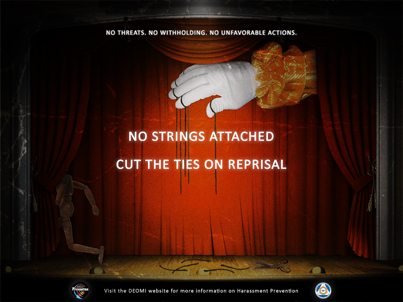
In accordance with Section 1034 of Title 10, U.S.C., as implemented by DoDD 7050.06, reprisal is defined as taking or threatening to take an unfavorable personnel action, or withholding or threatening to withhold a favorable personnel action, for making, preparing to make, or being perceived as making or preparing to make a protected communication.
Note: This does not apply to DoD Civilians, who should refer to DoD Instruction 1020.04
Reprisal Products
➤ Reprisal Overview
➤ Reprisal Fact Sheet
Posters
Click on the poster image(s) to download the full-sized product.
RETALIATION
Definition
Retaliation encompasses illegal, impermissible, or hostile actions taken by a Service members' chain of command, peers, or coworkers as a result of making or being suspected of making a protected communication in accordance with DoDD 7050.66. Retaliation for reporting a criminal offense can occur in several ways, including reprisal. Investigation of complaints of non-criminal retaliatory actions other than reprisal will be processed consistent with Service-specific regulations. In addition to reprisal, defined in Paragraph 3.7, additional retaliatory behaviors include ostracism, maltreatment, and criminal acts for a retaliatory purpose in connection with an alleged sex-related offense or sexual harassment; or for performance of duties concerning an alleged sex-related offense of sexual harassment.
Retaliation is conduct that punishes a DoD civilian employee for asserting the right to be free from harassment in the workplace. Retaliatory behaviors include, but are not limited to, reprisal, ostracism, maltreatment, and criminal acts for a retaliatory purpose. Retaliation includes illegal, impermissible, or hostile actions taken with the knowledge of management against DoD civilian employees for: Filing or being a witness in a charge, report, inquiry, or lawsuit; Communicating with a supervisor or manager about discrimination, including harassment; Answering questions during a DoD Component inquiry of alleged harassment; Refusing to follow orders that would result in harassment; or Resisting sexual advances or intervening to protect others.
For detailed definitions of the full range of retaliatory behaviors, see the RPRS Implementation Plan.
Retaliation Products
➤ Retaliation Quiz
➤ Retaliation Fact Sheet
➤ Retaliation Screen Reader Fact Sheet
Prevention Principles
➤ Orientation Paper